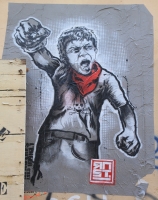
I. THE PLACE OF THE COMMUNE IN SOCIALIST EVOLUTION On March 18, 1871, the people of Paris rose against a despised and detested government, and proclaimed the city independent free, belonging to itself. This overthrow of the central power took place without the usual stage effects of revolution, without the firing of guns, without the shedding of blood upon barricades. When the armed people came out into the streets, the rulers fled away, the troops evacuated the town, the civil functionaries hurriedly retreated to Versailles carrying everything they could with them. The government evaporated like a pond of stagnant water in a spring breeze, and on the nineteenth the great city of Paris found herself free from the impurity which had defiled ... (From : Anarchy Archives.)
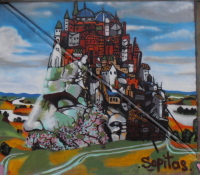
A Paper on Communism and Anarchism, By John Most New York, Bernhard & Schenck, 167 William Street, 1890. A DAGGER in one hand, a torch in the other, and all his pockets brimful with dynamite-bombs -- that is the picture of the anarchist, such as it has been drawn by his enemies. They look at him simply as a mixture of a fool and a knave, whose able, purpose is universal topsy-turvy, and whose only means to that purpose is to slay anyone and everyone who differs from him. The picture is an ugly carricature, but its general acceptance is not to be wondered at, since, for years all non-anarchistic papers have been busy in circulating it. Even in certain labor-organs one may find the anarchist represented as merely a man of violence, destit... (From : Anarchy Archives.)

Each day, in a whole range of tones, the bourgeois press praises the value and the importance of our political liberties, of the "political rights of the citizen": universal suffrage, free elections, freedom of the press and of meeting, etc. "Since you have these freedoms," they say to us, "what is the point of rebelling? Don't the liberties you already possess assure the possibilities of all the reforms that may be necessary, without your needing to resort to the gun?" So, let us analyze, from our point of view, what these famous "political liberties" are worth to the class that owns nothing, rules nobody, and has in fact very few rights and plenty of duties. We are not asserting, as has sometimes been said, that political rights have no value to us. We know very well that since the days of serfdom and even since the last century, we have made a certain amount of progress; the man of the people is no longer the being deprived of all rights that he was in...