
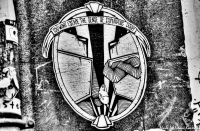
ANARCHISM: Its Philosophy and ldeal. Translated from the German by Harry Lyman Koopman. Ever reviled, accursed,-n'er understood, Thou art the grisly terror of our age. "Wreck of all order," cry the multitude, "Art thou, and war and murder's endless rage." O, let them cry. To them that ne'er have striven, The truth that lies behind a word to find, To them the word's right meaning was not given. They shall continue blind among the blind. But thou, O word, so clear, so strong, so pure, That sayest all which I for goal have taken. I give thee to the future! -Thine secure When each at last unto himself shall waken. Comes it in sunshine? In the tempest's thrill? I cannot tell......but it the earth shall see! I am an Anarchist! Wherefore I will No... (From : Anarchy Archives.)

We are living on the eve of great events. Before the end of this century has come we shall see great revolutionary movements breaking up our social conditions in Europe and probably also in the United States of America. Social storms cannot be forecast with the same accuracy as those which cross the Atlantic on their way to our shores. But still, there are tokens permitting us to predict the approach of those great disturbances which periodically visit mankind to redress wrongs accumulated by past centuries, to freshen the atmosphere, to blow away monopolies and prejudices. There is a certain periodicity in these great uprisings of the oppressed. The end of each of the last five centuries has been marked by great movements which have helped... (From : AnarchyArchives.)

These letters, addressed to Frederic Bastiat, an economist, originally appeared in a debate published in The Voice of the People, in 1849. Interest and Principal A Loan is a Service On the one hand, it is very true, as you have unquestionably established, that a loan is a service. And as every service has a value, and, in consequence, is entitled by its nature to a reward, it follows that a loan ought to have its price, or, to use the technical phrase, ought to bear interest. But it is also true, and this truth is consistent with the preceding one, that he who tends, under the ordinary conditions of the professional lender, does not deprive himself, as you phrase it, of the capital which be lends. He lends it, on the contrary, precisely bec... (From : Anarchy Archives.)

When Kropotkin was invited by Jean Grave, editor of Les Temps Nouveaux, to take part in a series of lectures to be held in the Milles Colonnes Hall in Paris in March 1896, he chose two subjects: The State: Its Historic Role and Anarchism: Its Philosophy and Its Ideal. Bearing in mind that his greatest work, Mutual Aid, had been appearing as a series of articles in The Nineteenth Century from 1890-1896 his choice of subjects for these lectures is not surprising. Kropotkin explains in the French edition of his Memoirs "The research that I carried out in the course of familiarizing myself with the institutions of the barbarian period and those of the free cities of the Middle Ages, led me to carry out further interesting research on the role played by the State during the last three centuries, from the time of its last incarnation in Europe. In addition the study of institutions of mutual aid in th...
First published in War Commentary - For Anarchism mid-march 1944. In no characteristic is existing society in the West so sharply distinguished from the earlier societies, whether of Europe or the East, than in its conception of time. To the ancient Chinese or Greek, to the Arab herdsman or Mexican peon of today, time is represented in the cyclic processes of nature, the alternation of day and night, the passage from season to season. The nomads and farmers measured and still measure their day from sunrise to sunset, and their year in terms of the seedtime and harvest, of the falling leaf and the ice thawing on the lakes and rivers. The farmer worked according to the elements, the craftsman for so long as he felt it necessary to perfect his... (From : Spunk.org.)

If the economic situation of Europe can be summed up in these words-industrial and commercial chaos and the failure of capitalist production-the situation in politics can be defined as the rapid breakdown of the State and its entire failure, which will take place very soon. Consider all the various States, from the police autocracy of Russia to the bourgeois oligarchy of Switzerland, and you will not find a single example today (with the possible exception of Sweden and Norway) of a State that is not set on an accelerating course towards disintegration and eventually, revolution. Like wornout old men, their skin shriveled and their feet stumbling, gnawed at by mortal sicknesses, incapable of embarking on the tide of new ideas, the States of Europe squander what strength remains to them, and while living on credit of their past, they merely hasten their ends by squabbling like aged gossips. Having reached a high point in the eighteenth cen...