(The last word of Angiolillo.) GERMINAL!--The Field of Mars is plowing, And hard the steel that cuts, and hot the breath Of the great Oxen, straining flanks and bowing Beneath his goad, who guides the share of Death. GERMINAL!--The Dragon's teeth are sowing, And stern and white the sower flings the seed He shall not gather, though full swift the growing; Straight down Death's furrow treads, and does not heed. GERMINAL!--The Helmet Heads are springing Far up the Field of Mars in gleaming files; With wild war notes the bursting earth is ringing. &... (From : Anarchy Archives.)
1. The Vietnam War and the crisis of Fordism The international economic context remained stable for over twenty years on the basis of what came out of the Bretton Woods conference in 1945: one dominant currency — the dollar, one leading country — the United States of America. The agreement, which was opposed by Lord Keynes, sanctioned the strength ratios that existed within the capitalist world at the end of the Second World War: not a collective government of the area dominated by private capital (as the British had wanted) but a vertical model in which the USA dominated the organs of international control e dictated the rules; in return they had to guarantee that their currency, imposed as the point of reference for trade, would remain stable and firmly linked to gold. While this was the situation with regard to international trade relations, the organizational model for production, and the social model linked to it, was and remai... (From : TheAnarchistLibrary.org.)
If you don’t like it, make your own
What is Black & Red? Black & Red is not a capitalist activity. It is anti-capitalist in its organization and its aims. Black & Red is a subversive action, and in this it is not Liberal. Its present field of action is the student milieu, but Black & Red is not a new intellectual current, a new “cultural trend” within the Capitalist University. Black & Red is a new front in the world anti-capitalist struggle. It is an organic link between the theory-action of the world revolutionary movement and the action-theory of the new revolutionary front. Its aim is: “To create at long last a situation which goes beyond the point of no return” (International Situationists). Black & Red is an anti-capitalist activity The production of Black & Red is not capitalist production. It is no... (From : TheAnarchistLibrary.org.)
Organizing for Attack
“From a certain point onward, there is no turning back. That is the point that must be reached.” – Franz Kafka. For us anarchists the questions of how to act and how to organize are intimately linked. And it is these two questions, not the question of the desired form of a future society, that provide us with the most useful method for understanding the various forms of anarchism that exist. Insurrectionary anarchism is one such form, although it is important to stress that insurrectionary anarchists don’t form one unified block, but are extremely varied in their perspectives. Insurrectionary anarchism is not an ideological solution to social problems, nor a commodity on the capitalist market of ideologies and opinions. Rather it is an on-going practice aimed at putting an end to the domination of the state and the continuance of capitalism, which requires analys... (From : TheAnarchistLibrary.org.)
The Committee of the Society for the Protection of Ancient Buildings has noted with much interest and satisfaction the letter of your correspondent in your impression of the 19th May, & has directed me to write to you, begging you, since the Society was mentioned in the letter, to insert a few words explanatory of its views on this point. The Committee are aware that the building needs repair badly enough; but it cannot help feeling that the plan of raising it bodily is fraught with danger to the fabric, however skillful may be the engineer who conducts the operation: the risk to the precious mosaics at any rate is undeniable, whatever may happen to the main structure of the walls, and these mosaics are in fact the very thing about the building thatit is worth spending money and pains to preserve: it need scarcely be said that if they be shattered to pieces by the proposed e... (From : Marxists.org.)
(1885 - 1923) : Ōsugi Sakae (大杉 栄) was a radical Japanese anarchist. He published numerous anarchist periodicals, helped translate western anarchist essays into Japanese for the first time, and created Japan's first Esperanto school in 1906. He, Noe Itō, and his nephew were murdered in what became known as the Amakasu incident.
In a society placing great value on imposed learning, Amos Keppler has taught himself everything he knows. Among those many things are writing, acting, photography and playing music and theater. He is a radical environmental activist, an eclectic witch emphasizing humanity's unbreakable bond with nature. Season of the Witch is the sixteenth book he has published in seven years. He isn't really that prolific, though, but just had lots of books ready for publication. (From : books.google.com.)
Nathan Goodman is a PhD student in economics at George Mason University. Previously, he was the Lysander Spooner Research Scholar in Abolitionist Studies at the Center for a Stateless Society (C4SS). His research interests include mass incarceration, Austrian economics, public choice, Bloomington school institutional analysis, and analytical anarchism. (From : c4ss.com.)
(2001 - )
Interview with Ernesto Aguilar of the Anarchist People of Color (APOC) The anarchist people of color movement has been around for a long time. Martin Sostre is one of the best-known people of color in contemporary history to articulate anarchist politics, as was Kuwasi Balagoon. Today, Ashanti Alston and Lorenzo Komboa Ervin are two of the most visible anti-authoritarians of color, but this movement is decentralized and diverse. There is no formal APOC organization at this point. In 2001, I founded an email list and website called Anarchist People of Color, and much activity — including the conference — has developed out of them. Getting to that point owes a lot to the past, though. My involvement was borne out of a few things. Back in the early 1990s, I was part of a Houston anarchist collective called Black Fist, which was active around issues of self-determination, anarchism and race. And I talked with so many other people of color who were,... (From : ColoursOfResistance.org.)
If our social arrangements were so adjusted that each person could follow that calling in life which they are by nature adapted for, what a great gainer society as a whole would be. These few who are so fortunate as to be able to follow the calling of their heart’s desire make a success of life. Florence Nightingale was one of the fortunate few, who could engage in that occupation for which she was best adapted. Florence Nightingale was a born nurse. In her was found that rare combination of heart, brain and sympathy which makes the ideal nurse. It is when one is laid low by the ravages of disease that they can appreciate to its utmost depth the value of human kindness. Many charming stories are told of Florence’s sympathetic nature even in her childhood: how she sought out wounded animals, and tenderly nursed them, and how she would scientifically bandage her dolls and would work earnestly at this occupation for hours at a time. Florence Night... (From : TheAnarchistLibrary.org.)
We boast of the age of advancement, of science, and progress. Is it not strange, then, that we still believe in fetish worship? True, our fetishes have different form and substance, yet in their power over the human mind they are still as disastrous as were those of old. Our modern fetish is universal suffrage. Those who have not yet achieved that goal fight bloody revolutions to obtain it, and those who have enjoyed its reign bring heavy sacrifice to the altar of this omnipotent deity. Woe to the heretic who dare question that divinity! Woman, even more than man, is a fetish worshiper, and though her idols may change, she is ever on her knees, ever holding up her hands, ever blind to the fact that her god has feet of clay. Thus woman has been the greatest supporter of all deities from time immemorial. Thus, too, she has had to pay the price that only gods can exact,--her freedom, her heart's blood, her very life. Nietzsche's memorable maxim, "When... (From : Anarchy Archives.)
Mary Wollstonecraft was born on the 27th of April, 1759. Her father—a quick-tempered and unsettled man, capable of beating wife, or child, or dog—was the son of a manufacturer who made money in Spitalfields, when Spitalfields was prosperous. Her mother was a rigorous Irishwoman, of the Dixons of Ballyshannon. Edward John Wollstonecraft—of whose children, besides Mary, the second child, three sons and two daughters lived to be men and women—in course of the got rid of about ten thousand pounds, which had been left him by his father. He began to get rid of it by farming. Mary Wollstonecraft’s first-remembered home was in a farm at Epping. When she was five years old the family moved to another farm, by the Chelmsford Road. When she was between six and seven years old they moved again, to the neighborhood of Barking. There they remained three years before the next move, which was to a farm near Beverley, in...
How many are there of the countless millions who have entered this life, passed through its changing scenes and at last have laid down to rest, of whom it can be truly said, “Here rest they who have labored for the uplifting of the oppressed, who have devoted their energies unstintingly in the interest of the ‘common people?’” We fear there are few indeed. A life devoted to the interest of the working class; a life of self-abnegation, a life full of love, kindness, gentleness, tragedy, activity, sadness and kind-ness, are some of the characteristics which went to make up the varied life of our comrade, Louise Michel. In the elderly woman, clad in simple black garments, with gray hair curling upon rounded shoulders and kindest of blue eyes glancing from the strongly marked face, none but those who knew her personally would in the last few years have recognized Louise Michel. Listening to her quiet musical voice, with its slightly ris... (From : TheAnarchistLibrary.org.)
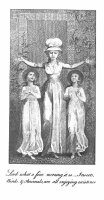
The next morning Mrs. Mason met them first in the garden; and she desired Caroline to look at a bed of tulips, that were then in their highest state of perfection. I, added she, choose to have every kind of flower in my garden, as the succession enables me to vary my daily prospect, and gives it the charm of variety; yet these tulips afford me less pleasure than most of the other sort which I cultivate—and I will tell you why—they are only beautiful. Listen to my distinction;—good features, and a fine complexion, I term bodily beauty. Like the streaks in the tulip, they please the eye for a moment; but this uniformity soon tires, and the active mind flies off to something else. The soul of beauty, my dear children, consists in the body gracefully exhibiting the emotions and variations of the informing mind. If truth, humanity, and knowledge inhabit the breast, the eyes will beam with a mild luster, modesty will suffuse the che...