
What is most significant, it seems to me, is the earnest attention paid to the Children and Family as a subject, the desire of parents to be Informed and thereby do their best, rather than following their wit and impulse; or to say this another way, what is significant is the importance assigned in our society to Psychology itself? for Psychology is still by and large the family-psychology that Freud made it discussing the problems of jealousy, infantile dependency authority, submissiveness and rebelliousness, and sibling competition: and problems of spite, moral prejudice and other reaction-formations springing from instinctual deprivation. This interest in the Children is of course hopeful, for the increase of wisdom cannot fail to remedy... (From : http://www.tao.ca/~freedom/goodman.html.)

So I lived, abandoning myself to this insanity for another six years, till my marriage. During that time I went abroad. Life in Europe and my acquaintance with leading and learned Europeans [Footnote: Russians generally make a distinction between Europeans and Russians. - A.M.] confirmed me yet more in the faith of striving after perfection in which I believed, for I found the same faith among them. That faith took with me the common form it assumes with the majority of educated people of our day. It was expressed by the word "progress". It then appeared to me that this word meant something. I did not as yet understand that, being tormented (like every vital man) by the question how it is best for me to live, in my answer, "Live in conformity with progress", I was like a man in a boat who when carried along by wind and waves should reply to what for him is the chief and only question. "whither to steer", by saying, "We are being carried somewhere". I did not...

In reply to "A project of anarchist organization" Dear Comrade Malatesta, I have read your response to the project for an 'Organizational Platform of a General Union of Anarchists', a project published by the group of Russian anarchists abroad. My impression is that either you have misunderstood the project for the 'Platform' or your refusal to recognize collective responsibility in revolutionary action and the directional function that the anarchist forces must take up, stems from a deep conviction about anarchism that leads you to disregard that principle of responsibility. Yet, it is a fundamental principle, which guides each one of us in our way of understanding the anarchist idea, in our determination that it should penetrate to the ma... (From : Flag.Blackened.net.)

When I left the Caucasus, they were still fighting there, and in the night it was dangerous to travel without a guard. I wanted to leave as early as possible, and so did not lie down to sleep. My friend came to see me off, and we sat the whole evening and night in the village street, in front of my cabin. It was a moonlit night with a mist, and so bright that one could read, though the moon was not to be seen. In the middle of the night we suddenly heard a pig squealing in the yard across the street. One of us cried: "A wolf is choking the pig!" I ran into the house, grasped a loaded gun, and ran into the street. They were all standing at the gate of the yard where the pig was squealing, and cried to me: "Here!" Milton rushed after me,—no doubt he thought that I was going out to hunt with the gun; but Búlka pricked his short ears, and tossed from side to side, as though to ask me whom he was to clutch. When I ran up to the wicke...

PREFACE Perhaps the argument most frequently used by conservative believers in the convenient doctrine of leaving things as they are against those engaged in reformatory efforts of a more or less radical nature is that the "spirit and genius of American institutions" do not admit of the assimilation or acceptance of the proposed innovations. Were one to trust them, the "American institutions" are something so clearly defined, finished, and powerful as to absolutely render it impossible for any inconsistent and discordant element to maintain a vigorous existence within the charmed circle which affords chances of life only to what necessarily and logically flows as a consequence from the fundamental principles supporting the peculiar civilization of this "best government on the face of the earth." We are asked to look upon all that "is," if not as unqualifiedly right and perfect, then as relatively so in the sense of its being the unavoidable outcome of primary conditions.

Note This book would not probably have been written for some time to come, but for the kind invitation and the most friendly encouragement of the editor and the publishers of "The Atlantic Monthly" to write it for serial publication in their magazine. I feel it a most pleasant duty to express here my very best thanks for the hospitality that was offered to me, and for the friendly pressure that was exercised to induce me to undertake this work. It was published in "The Atlantic Monthly" (September, 1898, to September, 1899), under the title, "The Autobiography of a Revolutionist." Preparing it now for publication in book form, I have added considerably to the original text in the parts dealing with my youth and my stay in Siberia, and especially in the Sixth Part, in which I have told the story of my life in Western Europe. P. KROPÓTKIN. BROMLEY...

NOTE TO SEVENTEENTH IMPRESSION WITH reference to certain statements on pages 44, 75, 131, and 132, it should be remarked that this book was written in the early part of 1912 when China was still an Empire, and the name of the then late Prime Minister did begin with the letter B. 1943...
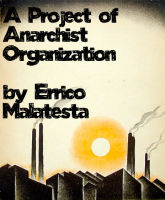
I recently happened to come across a French pamphlet (in Italy today , as is known, the non-fascist press cannot freely circulate), with the title 'Organizational Platform of the General Union of Anarchists (Project)'. This is a project for anarchist organization published under the name of a 'Group of Russian Anarchists Abroad' and it seems to be directed particularly at Russian comrades. But it deals with questions of equal interest to all anarchists; and it is, clear, including the language in which it is written, that it seeks the support of comrades worldwide. In any case it is worth examining, for the Russians as for everyone, whether the proposal put forward is in keeping with anarchist principles and whether implementation would tru... (From : Anarchy Archives.)

The following text is Stirner's first publication, which previous collections of Stirner's writings do not contain. Review of: Theodor Rohmer: German occupation in the present. Zurich and Winterthur: Publishing house of the literary Comptoirs 1841 in: The railroad. A support leaf for the formed world (Leipzig), 4th Jg., no. 77/78 (28./30.12.1841), S.307-308, 310-312 Max Stirner: "You only have the courage to be destructive" How happy I was as a child to lie on green fields and look up into blue skies. The sweet smells of Spring would waft through the air as dreamed of my bright future. I dreamed of becoming a great man. I would throw fistfuls of gold out of my carriage and masses of poor and stunned people would worship me. I would build fa... (From : Anarchy Archives.)