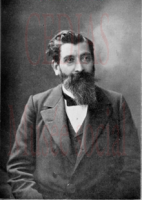
After the execution Kōtoku Shūsui in 1911 , Ōsugi Sakae (1885–1923) became one of the leading anarchists in japan. He had escaped arrest in the high treason trial that sent Kōtoku, Kanno and the others to their deaths because he was already in prison for his anarchist activities. He advocated and practiced free love, and was an early Japanese proponent of anarcho-syndicalism. Initially sympathetic to the Russian Revolution, he became a critic of Bolshevism and translated essays by Emma Goldman and Alexander Berkman exposing the Bolshevik dictatorship. III 1 923, Ōsugi, his lover, the anarchist feminist Ito Noe, and Ōsugi’s six year old nephew were brutally murdered by the Japanese military police. The followillg excerpts are from Yoshiharu Hashimoto‘s translation of Ōsugi’s declaration from 1920, “A So cialized Idealism,” in A Short History of the Anarchist Movement in Japan (Tokyo: Idea Pu... (From : TheAnarchistLibrary.org.)
An anarchist history
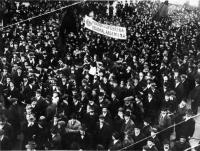
May 1st is a day of special significance for the labor movement. While it has been hijacked in the past by the Stalinist bureaucracy in the Soviet Union and elsewhere, the labor movement festival of May Day is a day of world-wide solidarity. A time to remember past struggles and demonstrate our hope for a better future. A day to remember that an injury to one is an injury to all. The history of Mayday is closely linked with the anarchist movement and the struggles of working people for a better world. Indeed, it originated with the execution of four anarchists in Chicago in 1886 for organizing workers in the fight for the eight-hour day. Thus May Day is a product of “anarchy in action” — of the struggle of working people using direct action in labor unions to change the world (“Anarchism ... originated in everyday struggles” — Kropotkin) It began in the 1880s in the USA. (From : TheAnarchistLibrary.org.)
Revolutionary thinkers have been saying that the age of vanguardism is over for most of a century now. Outside of a handful of tiny sectarian groups, it’s almost impossible to find a radical intellectuals seriously believe that their role should be to determine the correct historical analysis of the world situation, so as to lead the masses along in the one true revolutionary direction. But (rather like the idea of progress itself, to which it’s obviously connected), it seems much easier to renounce the principle than to shake the accompanying habits of thought. Vanguardist, even, sectarian attitudes have become deeply ingrained in academic radicalism it’s hard to say what it would mean to think outside them. The depth of the problem first really struck me when I first became acquainted with the consensus modes of decision-making employed in North American anarchist and anarchist-inspired political movements, which, in turn, bore a lot of similar... (From : TheAnarchistLibrary.org.)
• "Peace ought to be imposed by bringing about the Revolution, or at least by threatening to do so. To the present time, the strength or the skill is wanting.
Well! There is only one remedy: to do better in future. More than ever we must avoid compromise; deepen the chasm between capitalists and wage slaves, between rulers and ruled; preach expropriation of private property and the destruction of States as the only means of guaranteeing fraternity between the peoples and Justice and Liberty for all; and we must prepare to accomplish these things."
• "During the present war we have seen Republicans placing themselves at the service of kings, Socialists making common the cause with the ruling class, Laborists serving the interests of capitalists; but in reality all these people are, in varying degrees, Conservatives—believers in the mission of the State, and their hesitation can be understood when the only remedy lay in the destruction of every Governmental chain and the unloosing of the Social Revolution. But such hesitation is incomprehensible in the case of Anarchists."
• "Today, as ever, let this be our slogan: Down with Capitalists and Governments, all Capitalists and Governments!
Long live the peoples, all the peoples!"
History is one more battlefield among the many that exist in the class war. We must learn the lessons of the defeats of the proletariat, because they are the milestones of victory. History is one more battlefield among the many that exist in the class struggle. It is not just a matter of recovering the memory of the class struggles of the past, but also of fighting for history from the revolutionary point of view, that is, from the point of view of the defense of the historical interests of the proletariat, which can be nothing else than that of the THEORIZATION of the historical experiences of the international workers movement. Neither the economy, nor literature, nor cinema, nor politics, nor history, nor any other field of culture is neutral, nor can any of them ever be neutral, in a society that is divided into classes, because they comprise a ruthless battlefield. We are speaking of the understanding an... (From : TheAnarchistLibrary.org.)
(1844 - 1912) ~ French Socialist, IWMA Radical, and Leader of the Possibilist Movement : Paul Brousse was then a young doctor, full of mental activity, uproarious, sharp, lively, ready to develop any idea with a geometrical logic to its utmost consequences; powerful in his criticisms of the state and state organization... (From : Memoirs of a Revolutionist.)
• "Make the Revolution or die." (From : "Anarchist Portraits," by Paul Avrich, chapter 18.)
• "The Commune is the vehicle of the Revolution." (From : "Anarchist Portraits," by Paul Avrich, chapter 18.)
• "I'm demanding the complete, definitive, absolute emancipation of all workers." (From : "Anarchist Portraits," by Paul Avrich, chapter 18.)
(1952 - )
Alan Brian Carter (born 1952, Lincolnshire, England) is Emeritus Professor of Moral Philosophy at the University of Glasgow. Carter earned a BA at the University of Kent at Canterbury, a MA at the University of Sussex and a DPhil at St Cross College at the University of Oxford. Carter's first academic position was Lecturer in Political Theory at University College Dublin. He then became Head of the Philosophy Department at Heythrop College, University of London. Subsequently, he was Professor of Philosophy and Environmental Studies at the University of Colorado at Boulder. He has been a Visiting Professor at the University of British Columbia and at the University of Bucharest. For a number of years Carter was joint editor of the Journal of Applied Philosophy. He works principally in political philosophy, moral philosophy, and environmental philosophy. Carter has published on a wide range of topics: within political philosophy he has written on political obligation... (From : Wikipedia.org.)
(1955 - )
The FACA became the Argentine Libertarian Federation (FLA) in 1955, but like its predecessor organization was never able to gain a mass following. In 1985, the FLA replaced its newspaper Acción Libertaria with a new political journal called El Libertario. The 2001 unrest in Argentina and resulting episodes of workers' control have been of great interest to anarchists. (From : Wikipedia.org.)
(1995 - )
Sitting in a haze of exhaustion. The modern world runs on this same sleep deficit. The primary experience in this modern world is work. But work is no longer confined to the factory or the office but rather spills over everywhere. Today work is decomposed into its component parts - boredom, frenzy, effort, distraction and sloth. Even if you are unemployed, you can get much of the experience of a job just by driving through downtown, standing in a welfare line or going to the emergency ward. (From : ASAN Introduction.)
The Pioneers of human progress are like the Seagulls, they behold new coasts, new spheres of daring thought, when their co-voyagers see only the endless stretch of water. They send joyous greetings to the distant lands. Intense, yearning, burning faith pierces the clouds of doubt, because the sharp ears of the harbingers of life discern from the maddening roar of the waves, the new message, the new symbol for humanity. The latter does not grasp the new, dull, and inert, it meets the pioneer of truth with misgivings and resentment, as the disturber of its peace, as the annihilator of all stable habits and traditions. Thus the pathfinders are heard only by the few, because they will not tread the beaten tracks, and the mass lacks the strength to follow into the unknown. In conflict with every institution of their time since they will not compromise, it is inevitable that the advance guards should become aliens to the very one[s] they wish to serve; t... (From : TheAnarchistLibrary.org.)
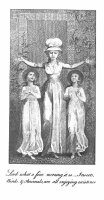
One fine morning in spring, some time after Mary and Caroline were settled in their new abode, Mrs. Mason proposed a walk before breakfast, a custom she wished to teach imperceptibly, by rendering it amusing. The sun had scarcely dispelled the dew that hung on every blade of grass, and filled the half-shut flowers; every prospect smiled, and the freshness of the air conveyed the most pleasing sensations to Mrs. Mason’s mind; but the children were regardless of the surrounding beauties, and ran eagerly after some insects to destroy them. Mrs. Mason silently observed their cruel sports, without appearing to do it; but stepping suddenly out of the foot-path into the long grass, her buckle was caught in it, and striving to disentangle herself, she wet her feet; which the children knew she wished to avoid, as she had been lately sick. This circumstance roused their attention; and they forgot their amusement to inquire why she had left the path; and Mary could...
I begin with an admission: Regardless of all political and economic theories, treating of the fundamental differences between various groups within the human race, regardless of class and race distinctions, regardless of all artificial boundary lines between woman's rights and man's rights, I hold that there is a point where these differentiations may meet and grow into one perfect whole. With this I do not mean to propose a peace treaty. The general social antagonism which has taken hold of our entire public life today, brought about through the force of opposing and contradictory interests, will crumble to pieces when the reorganization of our social life, based upon the principles of economic justice, shall have become a reality. Peace or harmony between the sexes and individuals does not necessarily depend on a superficial equalization of human beings; nor does it call for the elimination of individual traits and peculiarities. The problem that confron... (From : Anarchy Archives.)
I left East Rusoer the day before yesterday. The weather was very fine; but so calm that we loitered on the water near fourteen hours, only to make about six and twenty miles. It seemed to me a sort of emancipation when we landed at Helgeraac. The confinement which everywhere struck me whilst sojourning among the rocks, made me hail the earth as a land of promise; and the situation shone with fresh luster from the contrast—from appearing to be a free abode. Here it was possible to travel by land—I never thought this a comfort before—and my eyes, fatigued by the sparkling of the sun on the water, now contentedly reposed on the green expanse, half persuaded that such verdant meads had never till then regaled them. I rose early to pursue my journey to Tonsberg. The country still wore a face of joy—and my soul was alive to its charms. Leaving the most lofty and romantic of the cliffs behind us, we were almost contin...
Speaking of Puritanism in relation to American art, Mr. Gutzon Borglum said: "Puritanism has made us self-centered and hypocritical for so long, that sincerity and reverence for what is natural in our impulses have been fairly bred out of us, with the result that there can be neither truth nor individualility in our art." Mr. Borglum might have added that Puritanism has made life itself impossible. More than art, more than estheticism, life represents beauty in a thousand variations; it is indeed, a gigantic panorama of eternal change. Puritanism, on the other hand, rests on a fixed and immovable conception of life; it is based on the Calvinistic idea that life is a curse, imposed upon man by the wrath of God. In order to redeem himself man must do constant penance, must repudiate every natural and healthy impulse, and turn his back on joy and beauty. Puritanism celebrated its reign of terror in England during the sixteenth and seventeenth centuries, destr... (From : Anarchy Archives.)